Published
by Rogers Corporation
Elastomeric Material Solutions
When a material is introduced as a “more sustainable” alternative, engineers immediately ask a different question: does it perform the same?
With PORON® ReSource30 polyurethane foam, the objective was to reduce the material’s carbon footprint without altering the performance profile engineers associate with PORON® 4701-30 grade foam.
To understand how that balance was engineered and validated, we spoke with Rob Daniels, Principal Research and Development Engineer at Rogers Corporation, about formulation strategy, carbon measurement, and qualification testing.
The objective was to integrate sustainable raw materials into the PORON® 30 platform while holding critical performance targets constant.
The formulation incorporates a bio-based polyol and a recycled mineral filler within a modular system architecture. This allowed the R&D team to increase sustainable content without shifting compression force deflection curves, stress relaxation behavior, or long-term durability performance.
Performance parity was a non-negotiable requirement from the outset.
We approached carbon reduction the same way we approach performance: with structured analysis.
Carbon impact was evaluated using a cradle-to-gate, ISO-aligned life cycle assessment (LCA) consistent with IPCC 2013 GWP 100a methodology. This framework quantifies greenhouse gas emissions associated with raw materials and manufacturing inputs.
Our analysis showed that raw materials and manufacturing inputs account for roughly 90% of the material’s cradle-to-gate carbon footprint. That insight shaped the development strategy. By targeting raw material inputs first, the team was able to achieve measurable reductions while maintaining mechanical consistency.
As Rob explains:
“Measuring carbon through LCA gives you a defensible number. It shows where impact actually comes from and removes ambiguity.”
PORON ReSource30 material contains approximately 42% sustainable content by weight, combining bio-based and recycled inputs. From a carbon standpoint, two levels of reduction were achieved.
At the formulation level, PORON ReSource30 foam delivers:
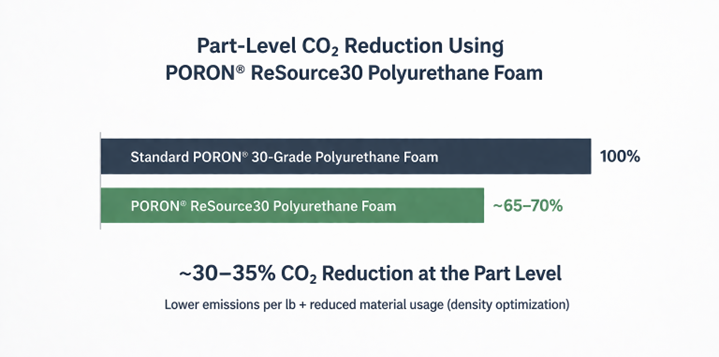
Beyond formulation changes, additional reductions are realized through density optimization. Lower-density variants were engineered to use approximately 20–25% less material while maintaining compressive force and sealing performance targets consistent with the PORON 30 range.
When both factors are combined, total part-level carbon savings can reach approximately 30–35%, depending on application geometry and thickness.
As Rob explains:
“The formulation gives you an immediate per-pound reduction. When you pair that with lower density while holding performance targets, the total impact becomes much more significant at the part level.”
Lower-density variants were intentionally engineered to maintain compressive force and long-term performance expectations, enabling material reduction without sacrificing cushioning or gasket reliability and translating directly into measurable carbon footprint reduction at the application level.
There is a long-standing perception in the market that bio-based or renewable materials compromise performance. Earlier generations of sustainable formulations across multiple industries reinforced that skepticism.
PORON ReSource30 material was developed with that history in mind. Qualification testing was structured specifically to confirm that integrating bio-based polyols and recycled content would not degrade compression set, stress relaxation, or long-term durability.
Testing confirmed compression set and stress relaxation performance consistent with established PORON 30-grade benchmarks across standard densities. Long-term environmental aging behavior was also evaluated to ensure alignment with durability expectations under thermal and humidity exposure.
Adhesion performance in internal peel testing is aligned with PORON® 30 and 40 material grades, and OEM adhesive evaluations have not identified concerns. In addition, abrasion resistance improvements were observed, driven by formulation adjustments and crosslink density optimization.
From a user standpoint, the material is visually and tactilely indistinguishable from incumbent grades.
Global feasibility and qualification trials further validated processing consistency and scalability across production sites.
Integrating sustainable raw materials into a high-performance polyurethane system introduces variability that must be carefully managed.
Bio-based polyols can vary significantly in consistency and mechanical behavior. Some also introduce noticeable odor profiles, which can be unacceptable in consumer-facing applications.
For PORON ReSource30 foam, material selection was deliberate. The chosen bio-based system was screened for mechanical stability, processing consistency, and minimal odor impact to ensure alignment with established PORON® material performance expectations.
Feedstock sourcing was another consideration. PORON ReSource30 foam does not rely on materials that compete directly with food supply chains, avoiding concerns common to corn- or soy-derived systems.
Validation was treated with the same rigor as performance testing.
PORON ReSource30 foam sustainability claims are supported by structured, traceable methodologies. They are not based on mass-balance accounting, carbon credit offsets, or “sequestered carbon” modifiers.
Validation included:
PORON ReSource30 foam is evaluated under the same compliance framework applied across the PORON material portfolio.
This includes applicable UL certifications, REACH regulation framework, RoHS evaluation, and halogen testing. Additional third-party or customer-specific testing can be supported as required.
Introducing sustainable content does not alter the regulatory pathway or increase qualification risk.
Like other PORON polyurethane materials, PORON ReSource30 is a thermoset designed for long-term mechanical stability throughout the product life cycle. It can be recycled through established industrial methods such as mechanical, chemical, and feedstock recycling.
Its sustainability profile is driven by reduced cradle-to-gate greenhouse gas emissions and extended service life.
Engineers can evaluate PORON ReSource30 foam using the same design framework applied to PORON 30-grade materials.
Compression behavior, stress relaxation performance, adhesion characteristics, and long-term durability are engineered to meet the same performance expectations. The difference is a measurable reduction in cradle-to-gate emissions reduction, validated through life cycle analysis and third-party testing.
PORON ReSource30 material was developed to deliver verified emissions reduction while maintaining the mechanical reliability engineers expect from the PORON 30 material range.
Request a sample or connect with a Rogers sales engineer to discuss application-specific evaluation.
Published on Apr 17, 2026