Published
by Rogers Corporation
Advanced Electronics Solutions
Ultra-Wideband (UWB) has evolved into a mass market wireless platform enabling high precision positioning, secure connectivity, and sensing across consumer electronics, automotive, industrial, and IoT applications. Already embedded in smartphones, vehicles, industrial infrastructure, and smart buildings, UWB is redefining how systems understand distance, location, motion, and presence, particularly in environments where traditional wireless technologies reach their limits.
Unlike satellite based positioning systems such as GPS, which are designed for outdoor, wide area coverage, UWB is optimized for short range, infrastructure based localization. Compared with Bluetooth® and Wi Fi®, which rely largely on signal strength for positioning, UWB uses precise timing information to determine distance. This allows UWB systems to deliver significantly higher accuracy, improved robustness in dense environments, and enhanced security.
By 2026, UWB has transitioned from an emerging technology into a mature and rapidly scaling platform, driven by ecosystem standardization, widespread device integration, and an expanding range of multi function use cases.
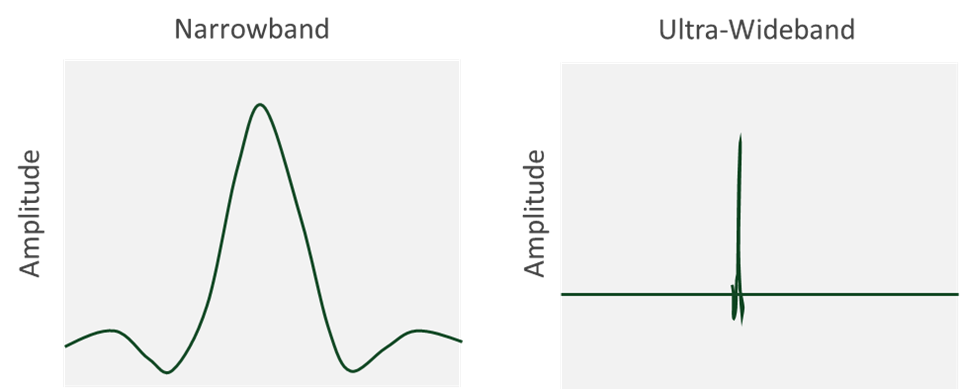
Ultra-Wideband is a short range radio technology that transmits information using extremely wide bandwidths, typically 500 MHz (or more) per channel, at very low power spectral density. Instead of relying on continuous sinusoidal carriers like most wireless technologies, UWB uses extremely short nanosecond scale time domain pulses, typically 1-2 nanoseconds wide. These brief pulses are precisely time stamped at both transmission and reception. Because of this inverse relationship between pulse duration and bandwidth, these short pulses naturally occupy the wide spectrum required for UWB operation.
At the core of UWB is Angle of arrival (AoA) and time of flight (ToF) measurement. By measuring how long it takes for a pulse to travel between devices or infrastructure anchors (at the speed of light), UWB systems can determine true distance with centimeter level accuracy. This approach is fundamentally different from RSSI based positioning used by Bluetooth and Wi Fi, which estimates distance indirectly from signal strength and is far more susceptible to environmental variation such as multipath, obstacles, and interference.
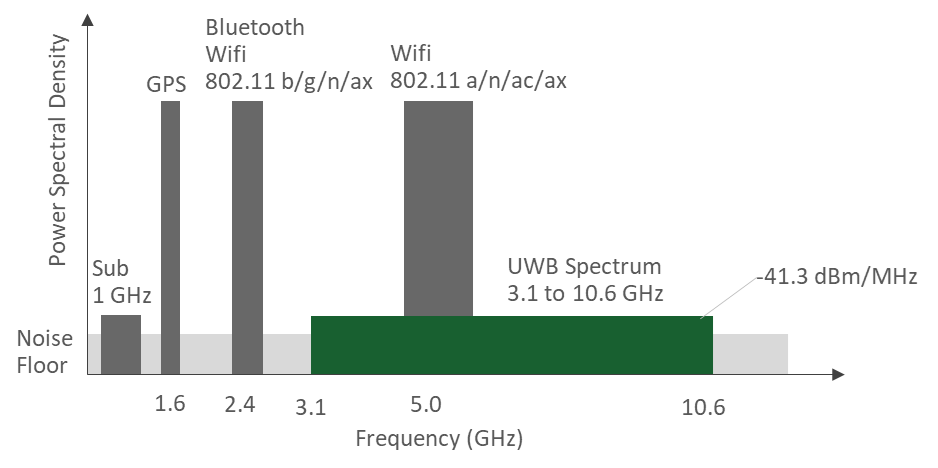
Fig. 1.: Qualitative Comparison of the Power Spectral Density Bandwidth between the UWB Wireless Communication Method and Other Communication Methods
UWB operates with a very low power spectral density (regulated at a maximum of -41.3 dBm/MHz in most regions). This is extremely low emission level, spread across the wide bandwidth, keeps the signal well below the noise floor of most other receivers. As a result, UWB causes negligible or no interference to coexisting technologies such as Wi-Fi, Bluetooth, cellular, or GPS, while still enabling robust short-range communication and precise ranging.
UWB’s pulse based operation provides several intrinsic advantages:
Beyond positioning and secure ranging, Ultra-Wideband (UWB) can function as a short-range, low-power radar. Using a single transceiver in mono-static mode, it sends pulses and analyzes reflections to detect tiny phase changes and Doppler shifts from motion.
Its wide bandwidth and nanosecond pulses deliver high spatial resolution and precise timing, enabling millimeter-level motion sensing, even at very low velocities. This makes UWB ideal for applications such as:
UWB thus combines communication, ranging, and environmental awareness on one versatile hardware platform.
Modern UWB systems are based on the IEEE 802.15.4 High Rate Pulse (HRP) UWB standard, which defines the physical and MAC layers required for secure and precise ranging.
The IEEE 802.15.4ab amendment, finalized in late 2025, significantly extends UWB capabilities by introducing:
With 802.15.4ab, UWB evolves from a ranging technology into a multi purpose platform supporting secure access, localization, communication, and sensing on the same hardware.
| Feature | Wi‑Fi | Bluetooth | UWB |
|---|---|---|---|
| Spectrum Band | 2.4 / 5 / 6 GHz | 2.4 GHz | 3.1 – 10 GHz |
| Nominal Accuracy | 3–5 m | 1–5 m | 10–30 cm |
| Range | 50–100 m | 10–50 m | Up to 200 m |
| Data Rate | Up to Gbps | Up to 2 Mbps | Up to ~125 Mbps |
| Security | Medium | Medium | High (cryptographic ToF, anti‑relay) |
| Interference Immunity | Medium | Low–Medium | High (wideband, below noise floor) |
| Power for Ranging | Medium–High | Low | Low (especially for tags) |
UWB’s combination of precision, security, and robustness makes it fundamentally different from conventional short range wireless solutions.
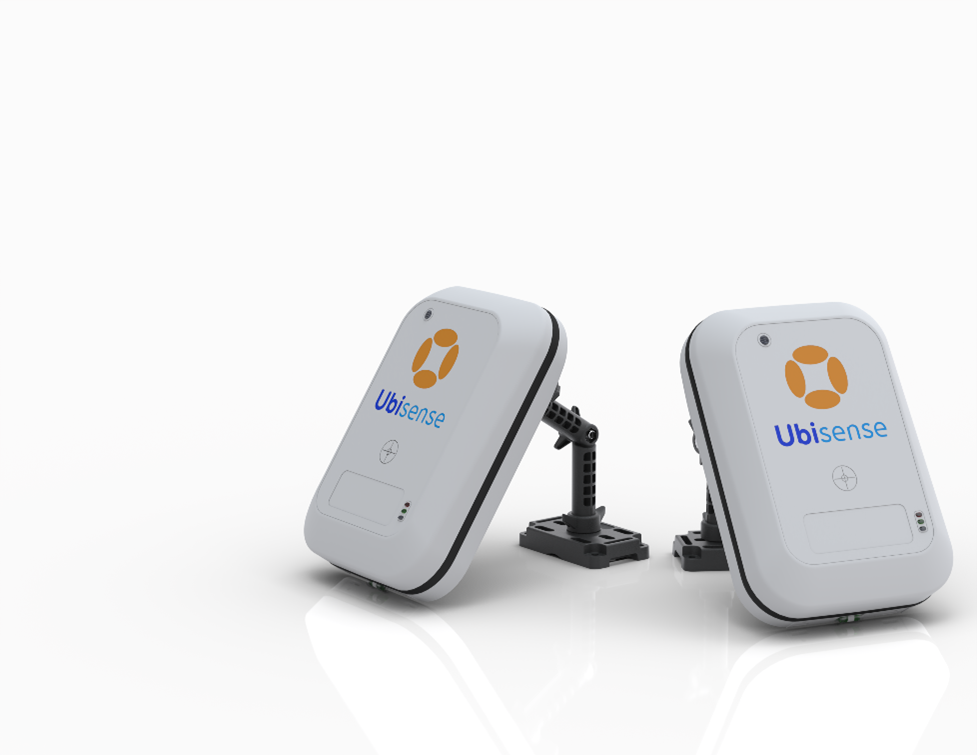
A standout example in the UWB RTLS space is Ubisense's Dimension4™ UWB hardware, which works in combination with the SmartSpace® real-time spatial intelligence platform. It achieves up to 3x more location information per tag transmission than typical competitors. While many UWB anchors rely on simple designs, such as a single or dual “antenna-on-chip” solution or external SMA-connected antennas attached to just two chips. Ubisense integrates a sophisticated array of multiple broadband patch antennas directly onto a complex, high frequency PCB built using advanced RF laminate materials. This precision engineered antenna array is the only one that captures time difference of arrival (TDoA) for accurate distance measurement, and also true 2 axis angle of arrival (AoA) in both azimuth and elevation.
As a result, each UWB pulse from a tag delivers three independent pieces of geometric data (range + horizontal angle + vertical angle) instead of distance alone. This richer data set enables true 3D positioning with fewer anchors, a wider field of view, and sub-15 cm accuracy even in challenging industrial environments. The extra complexity in the antenna design, enabled by a thicker, more sophisticated PCB — is what delivers this performance advantage over simpler competitor solutions.
Fig. 3. Ubisense Dimension4™ UWB (https://ubisense.com/)
With its combination of precise ranging, robustness, and multi function capability, UWB has become a foundational technology across a wide range of applications.
In the automotive sector, UWB enables secure digital key systems based on true distance measurement, significantly improving resistance to relay attacks. UWB is also increasingly used for in cabin sensing applications, including occupancy detection/child presence detection (CPD) and vital sign monitoring, and for emerging positioning use cases such as automated parking and high precision vehicle alignment.
By providing a shared spatial reference across large facilities, UWB enables accurate navigation, coordination, and automation of mobile assets within complex indoor environments.
For drones and unmanned platforms, UWB plays a key role in GPS denied environments, such as indoor inspection, inventory monitoring, industrial surveying, and confined or obstructed spaces. In these scenarios, UWB provides reliable infrastructure based positioning that supports controlled navigation, coordination with other mobile systems, and safe operation in shared environments.
UWB is now widely embedded in consumer devices, enabling applications such as secure access control, item finding, spatial awareness, and contextual interaction. In smart buildings and infrastructure, UWB supports occupancy sensing, access management, and location aware services.
By 2026, Ultra Wideband has clearly transitioned into a widely deployed, high growth platform:
With IEEE 802.15.4ab enabling standardized sensing, higher throughput, and improved scalability, UWB is becoming a unified technology platform for secure access, precise localization, wireless communication, and radar like sensing, often on the same hardware.
UWB is therefore poised to play a central role in next generation mobility, robotaxis, smart infrastructure, healthcare, and industrial automation.
Ultra-Wideband systems rely on very wide bandwidths, precise timing, and compact antenna integration, placing high demands on PCB materials. Low dielectric loss and stable electrical properties are essential to preserve pulse fidelity, ranging accuracy, and overall system robustness.
Rogers RO4835™ laminates are well suited for UWB applications, supporting consistent antenna performance and predictable RF behavior across the UWB frequency range, while remaining compatible with standard, high volume PCB fabrication processes. Another alternative represents Anteo™ laminates, a cost effective solution which provides dielectric constants (Dk) in alignment with FR-4 industry standards, simplifying the transition from existing FR-4 designs when superior electrical performance is required.
If you would like to discuss UWB material selection or learn how RO4835™ laminates or Anteo™ laminates can support your UWB designs, we encourage you to contact the Rogers team for further information.
Published on May 14, 2026