Published
by Rogers Corporation
Enclosure Institute
Image courtesy of Rogers Corporation
Welcome back to The Enclosure Institute™, your go-to resource for designing better-sealed, longer-lasting enclosures.
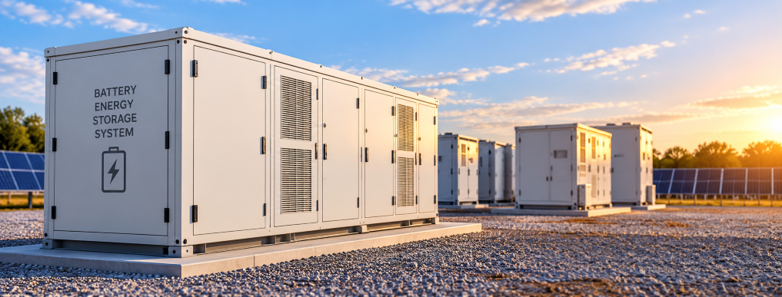
A battery energy storage system (BESS) can spend years outdoors with the same perimeter gasket compressed around its enclosure. Rain and dust are part of the challenge of the gasket continuing to seal effectively, but there’s more going on at the seal. Enclosure gaps vary, large panels aren't perfectly flat, fasteners pull harder in some areas than others, temperatures change, and the gasket itself can behave differently after years under compression.
For the Battery Energy Storage Systems (BESS) elective from The Enclosure Institute™, Rogers Corporation, 3M and Marian are looking at those details together, from the sealing material and adhesive to the finished converted gasket.
Here are six things we believe should be considered during the enclosure design:
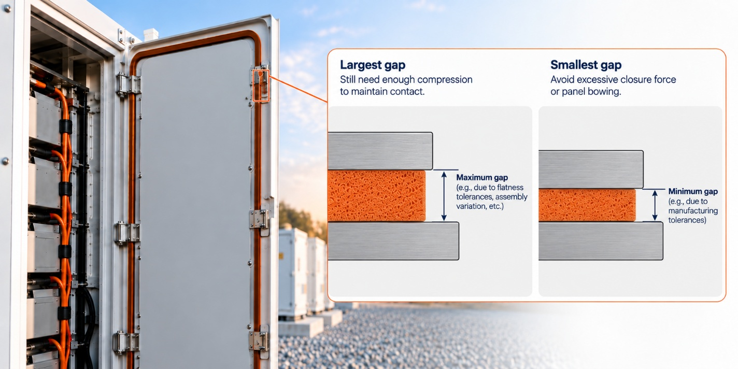
A drawing might show one gap between the enclosure flange and cover. In production, that dimension isn't going to be identical everywhere.
Flange flatness, manufacturing tolerances and assembly variation all affect how much space the gasket actually has to fill. On a larger BESS enclosure, you may be dealing with that variation across a pretty long sealing perimeter.
Instead of designing around one nominal gap, look at the extremes.
At the largest expected gap, there still needs to be enough gasket compression to maintain contact. At the smallest, you don't want excessive closure force or panel distortion.
That range is usually more useful when you're deciding on gasket thickness, firmness and target compression.
Image courtesy of Rogers Corporation
Fasteners and latches pull the cover toward the enclosure at specific points. The panel between them doesn't necessarily behave the same way, especially across a large door or cover.
A gasket could have plenty of compression next to a fastener and less compression farther away.
If an enclosure is leaking in one area, changing the foam isn't automatically the answer. Fastener spacing, flange geometry, panel stiffness and local gap variation can all change how the gasket is being loaded.
Image courtesy of Rogers Corporation
On a large BESS enclosure, the target compression percentage matters, but it also matters where you’re actually achieving it.
Take a short strip of foam and compress it by hand. No big deal, right?
Now run that material around a large BESS cabinet.
The force needed to compress the gasket is acting across the entire sealing area, so gasket width, firmness and compression all start to matter. The enclosure, fasteners and latches have to be able to apply that load without creating another problem somewhere else.
That’s why we recommend looking at closure force alongside conformability and long-term sealing performance.
More compression isn't automatically better. The gasket needs enough compression to conform and maintain the seal while staying within a closure force the enclosure can actually support.
Let’s go through an example on how to estimate the force needed to compress a gasket.
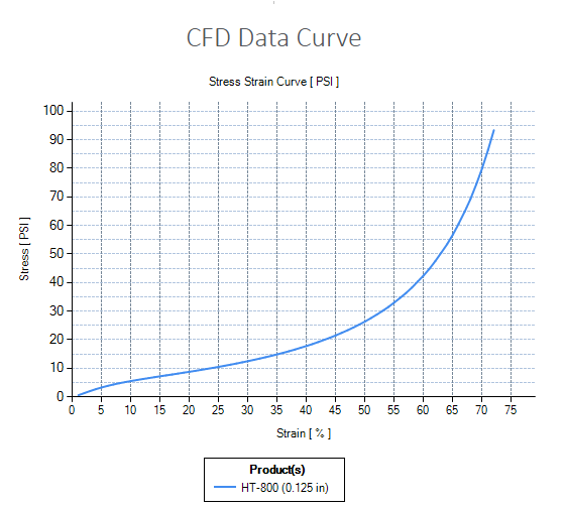
The compression force deflection (CFD) curve helps estimate the force needed to compress the full gasket.
Check out the Rogers Compression Force Deflection Tool for more data.
For example, the CFD curve for 0.125-inch-thick BISCO® HT-800 silicone foam shows 21.54 psi at 45% compression.
Assume a rectangular gasket with centerline dimensions of 36 × 24 inches and a uniform width of 0.5 inch:
That’s the estimated total force needed to compress this example gasket uniformly by 45%.
The cover, fasteners and latches need to distribute that load around the perimeter. Having enough total force doesn’t guarantee sufficient compression between fasteners, and this calculation does not represent the force required at a latch handle.
This is probably the biggest long-term question for an outdoor BESS enclosure.
A new gasket hasn't spent years compressed yet.
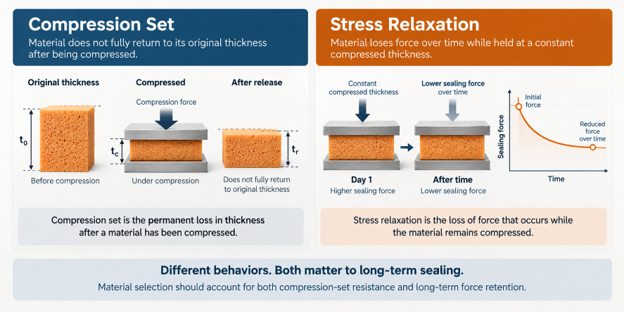
Compression set describes the permanent deformation left after a material has been compressed. Think of this as the memory of the material.
Stress relaxation is the loss of force that happens while the material remains under compression. Think of this as the constant force over a period.
They're different behaviors, and both can matter to a seal that may stay compressed for long periods.
Image courtesy of Rogers Corporation
Thickness loss from compression set develops over time and may not show up during initial testing. Stress relaxation matters for a different reason: the gasket can gradually lose some of the force it's applying against the mating surfaces.
We've seen what that can look like in a real outdoor energy enclosure.
In a documented solar combiner-box application, the original gasket took a compression set over time. Gaps developed around the door, rainwater entered the enclosure and the gasket had to be replaced repeatedly. The application was ultimately changed to using BISCO® HT-800 silicone foam for the gasket to improve long-term sealing performance.
While this was not specifically a BESS enclosure, the failure mode is very relevant to a BESS application: the gasket worked initially, then time under compression changed the seal.
Temperature range, sunlight exposure, moisture, enclosure construction and expected service life all matter. Temperature changes can also cause the enclosure itself to expand and contract, changing the gap the gasket has to fill.
This is where the properties of a material like BISCO® HT-800 silicone foam become useful. Designed for long term sealing, BISCO HT-800 material is available in multiple thicknesses and firmness options. Its silicone construction provides a broad temperature range and resistance to UV and ozone exposure, while its compression-set and stress-relaxation performance help support long-term sealing.
The application still comes first. The question isn't simply whether a material is suitable for outdoor use, but whether its properties match the BESS enclosure's actual temperature, compression, closure-force and service-life requirements.
Image courtesy of Rogers Corporation
BESS equipment may eventually need to be opened for inspection, maintenance or repair.
By then, the gasket may have spent years under compression. It needs to recover well enough to reseal when the cover goes back on, as ideally routine access shouldn’t turn into a gasket replacement project.
The manner by which the gasket is attached matters too.
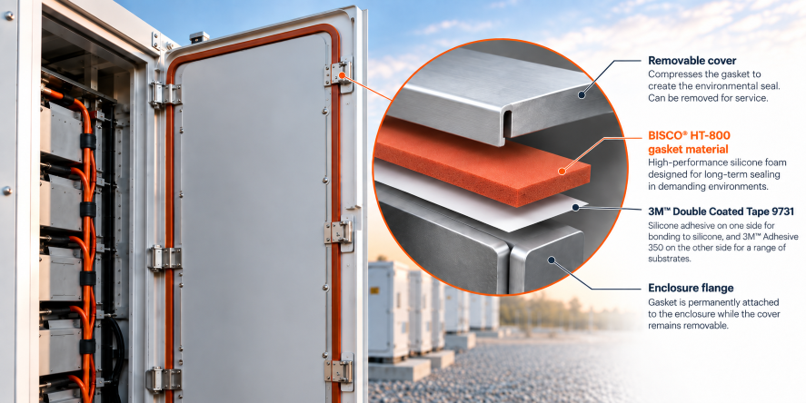
In the BESS application featured in our Enclosure Institute elective, Rogers BISCO HT-800 silicone is paired with 3M™ Double Coated Tape 9731. The differential adhesive construction is useful with silicone because one side is designed to bond to silicone surfaces, while the other uses 3M™ Adhesive 350 acrylic adhesive for bonding to a range of other substrates.
Marian laminates the materials and precision converts the construction into the required gasket geometry, so the OEM receives a finished component rather than separate layers that still need to be assembled.
There's a useful design detail here: the gasket can be permanently attached to the enclosure without permanently attaching the cover. The cover compresses the exposed foam and can still be removed when access is needed.
A BESS enclosure seal looks pretty straightforward when you see the finished gasket, but getting there takes different areas of expertise coming together.
Rogers Corporation brings the high-performance material to the application. 3M brings the adhesive technology. Marian brings those materials together through lamination and precision converting to create the finished gasket.
That's also the idea behind the Battery Energy Storage Systems elective from The Enclosure Institute™. Rather than looking at the foam, adhesive or converted part in isolation, we're looking at how those decisions come together in a real BESS enclosure.
Register to watch the Enclosure Institute™ In the Field episode to see Rogers, 3M and Marian walk through this BESS enclosure sealing application and explore the BESS elective for more information on designing and selecting materials for battery energy storage systems.
Sealing challenges can make or break an enclosure’s performance. Whether you're designing for environmental protection, long-term reliability, or compliance with industry standards, selecting the right materials and understanding effective sealing strategies are critical. That’s why Marian Inc. and Rogers Corporation have partnered to bring you the Enclosure Institute—a free learning platform designed to help engineers navigate the complexities of enclosure sealing.
Gain exclusive access to:
The Enclosure Institute is designed for engineers at all levels, whether you're new to enclosure sealing or looking to refine your expertise.
Enroll today to take the next step in mastering enclosure design.
If you have a specific enclosure challenge and need expert guidance, Marian’s team is ready to help. Contact Marian directly for tailored recommendations and support.
Not ready to enroll yet? Explore more blogs on enclosure design best practices:
With nearly 200 years of material expertise, 70 years of fabrication development, decades of partnership, and thousands of applications designed together, Marian and Rogers bring unmatched knowledge to enclosure sealing. By combining Rogers’ high-performance materials with Marian’s precision converting capabilities, we deliver custom-engineered solutions that enhance durability, reliability, and performance.
Whether you need expert guidance, high-quality materials, or precision-fabricated components, our partnership ensures your enclosures meet the highest industry standards while optimizing efficiency and cost-effectiveness.
If you have a specific enclosure challenge and need expert guidance, Marian’s team is ready to help. Contact Marian directly for tailored recommendations and support.
Published on Oct 12, 2026