Published
by Rogers Corporation
Enclosure Institute
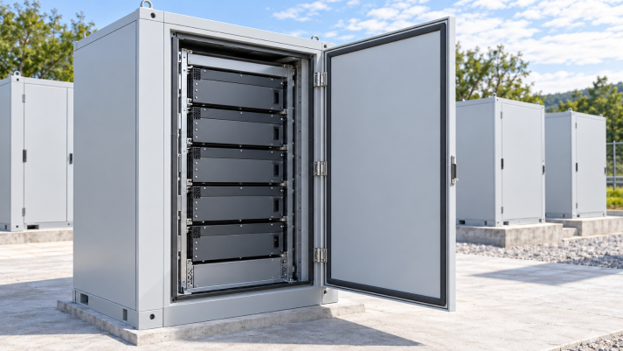
Image courtesy of Rogers Corporation
Welcome back to The Enclosure Institute™, your go-to resource for designing better-sealed, longer-lasting enclosures.
For our Battery Energy Storage Systems (BESS) elective, we’re taking The Enclosure Institute™ into the field. Rogers Corporation, 3M and Marian are looking at a BESS enclosure gasket and the decisions behind its complete construction, from the sealing material and adhesive to the finished converted part.
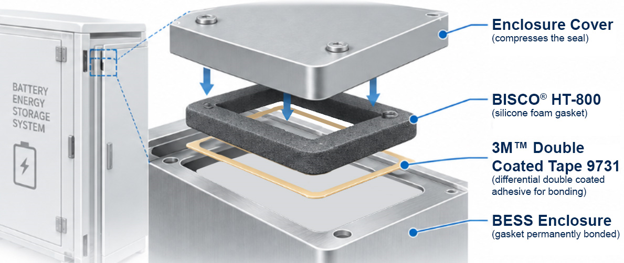
The application pairs BISCO® HT-800 silicone foam with 3M™ Double Coated Tape 9731 that Marian laminates and precision converts into a ready-to-install enclosure gasket.
Image courtesy of Rogers Corporation
The perimeter gasket helps keep water, dust and other contaminants away from the components inside the BESS enclosure. The challenge is making sure it can continue to do so over time.
In this application, BISCO® HT-800 silicone foam is compressed between the enclosure flange and a removable cover. The material needs to conform to the mating surfaces while maintaining enough thickness and sealing force to keep contact around the perimeter.
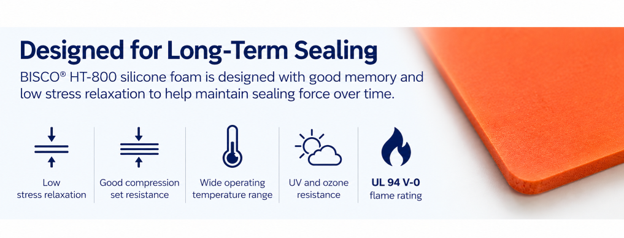
It is for this reason properties like compression set and stress relaxation are important.
Compression set describes the permanent deformation that remains after a material has been compressed and released. Stress relaxation describes the loss of force that occurs while the material remains compressed at a fixed deflection. Both properties affect the seal differently, but both become particularly important when a gasket spends years under compression.
BISCO HT-800 silicone foam is designed for long-term sealing performance, with excellent memory and low stress relaxation. Its silicone chemistry provides resistance to UV, ozone and extreme temperatures, and the material carries a UL 94 V-0 flame rating[DS3.1], keeping the functional parts inside the housing safe from hurricanes, blizzards, fires, and everything in between.
Image courtesy of Rogers Corporation
Of course, the material still has to work within the enclosure itself. Gasket compression, available closure force, flange geometry, operating temperature and the expected environment all need to be considered together.
How do you keep the silicone gasket attached to the enclosure?
Silicone can be difficult to bond with conventional pressure-sensitive adhesives. 3M™ Double Coated Tape 9731 uses a differential adhesive construction specifically suited to applications involving silicone. One side uses a silicone pressure-sensitive adhesive for bonding to silicone materials, while the other uses 3M™ Adhesive 350, a high-performance acrylic adhesive that bonds to a wide range of substrates. The tape’s thin polyester film carrier also makes it easier to handle during die cutting and lamination.
In this BESS construction, 9731 tape keeps the gasket attached and positioned on the enclosure while the removable cover compresses the exposed foam to create the environmental seal.
That also helps with serviceability. The gasket stays bonded to the enclosure, but the mating cover is not permanently bonded to it. As a result, the cover can still be removed when access is needed.
At this point in the process, you still don’t have a finished part.
The next step is Marian laminating the 3M adhesive to the BISCO silicone foam and precision converting the construction into the gasket geometry required by the enclosure. The finished part has to follow the flange, stay within the available sealing area and locate correctly during assembly.
Here is where material selection meets the drawing. Gasket geometry, tolerances, material thickness, adhesive construction and the way the part will actually be installed all have to work together.
For an OEM, the end result is a production-ready gasket rather than separate foam and adhesive materials that would need to be combined and converted to arrive at a finished gasket.
Rogers Corporation brings expertise in high-performance elastomeric materials and long-term sealing. 3M brings adhesive and bonding expertise, including solutions for challenging surfaces such as silicone. Marian brings the converting knowledge needed to turn those materials into a finished component that fits the enclosure and the assembly process.
For the design engineer, it means the material, adhesive and converted part can be considered as one sealing system rather than three separate decisions.
Register to watch the Enclosure Institute™ In the Field episode to see Rogers, 3M and Marian walk through this BESS enclosure sealing application and explore the BESS elective for more information on designing and selecting materials for battery energy storage systems.
Sealing challenges can make or break an enclosure’s performance. Whether you're designing for environmental protection, long-term reliability, or compliance with industry standards, selecting the right materials and understanding effective sealing strategies are critical. That’s why Marian Inc. and Rogers Corporation have partnered to bring you the Enclosure Institute—a free learning platform designed to help engineers navigate the complexities of enclosure sealing.
Gain exclusive access to:
The Enclosure Institute is designed for engineers at all levels, whether you're new to enclosure sealing or looking to refine your expertise.
Enroll today to take the next step in mastering enclosure design.
If you have a specific enclosure challenge and need expert guidance, Marian’s team is ready to help. Contact Marian directly for tailored recommendations and support.
Not ready to enroll yet? Explore more blogs on enclosure design best practices:
With nearly 200 years of material expertise, 70 years of fabrication development, decades of partnership, and thousands of applications designed together, Marian and Rogers bring unmatched knowledge to enclosure sealing. By combining Rogers’ high-performance materials with Marian’s precision converting capabilities, we deliver custom-engineered solutions that enhance durability, reliability, and performance.
Whether you need expert guidance, high-quality materials, or precision-fabricated components, our partnership ensures your enclosures meet the highest industry standards while optimizing efficiency and cost-effectiveness.
If you have a specific enclosure challenge and need expert guidance, Marian’s team is ready to help. Contact Marian directly for tailored recommendations and support.
Published on Oct 12, 2026