Published
by Rogers Corporation
Elastomeric Material Solutions, Enclosure Institute
Welcome back to The Enclosure Institute™—your go-to resource for designing better-sealed, longer-lasting enclosures.
In this special elective with 3M™, we’re exploring what foam bonding failure modes can reveal about adhesive performance.
Sometimes during peel testing, the adhesive never releases. The foam ends up tearing first.
That can indicate that the bond exceeded the foam’s internal strength under the test conditions, an insight that could be missed when engineers look only at the measured peel value.
To better understand these interactions, Rogers and 3M™ teamed up to evaluate selected PORON® polyurethane and BISCO® silicone foams with pressure-sensitive adhesive constructions under controlled conditions, with Marian bringing the converting perspective as a Preferred Converter for both companies.
Let’s examine clean peel, foam split, and foam tear, and what each failure mode reveals about the tested construction.
When the foam tears before the adhesive releases, the failure mode provides important context that a peel value alone cannot.
A peel test applies a separating force to a bonded construction under defined conditions. The resulting peel value can help engineers compare foam and adhesive combinations, but the number alone doesn’t tell the whole story.
Engineers should also consider the failure mode, or where and how the construction separated.
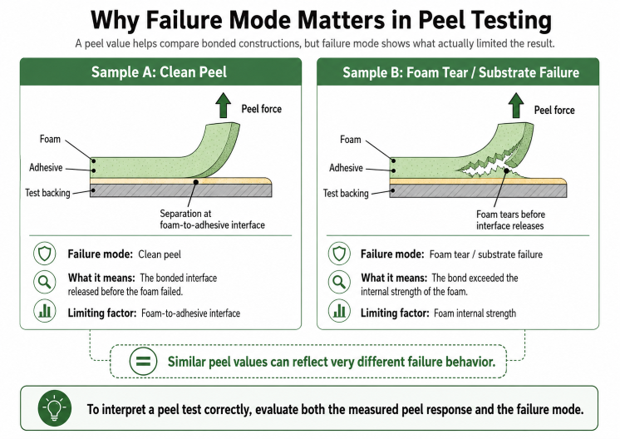
Consider two samples:
Even if the measured peel values are similar, the constructions did not behave in the same way.
The first result was limited by the foam-to-adhesive interface. The second was limited by the internal strength of the foam.
That distinction can help engineers understand whether the interface released first or whether the foam itself became the limiting factor.
The Rogers and 3M bonding study documented three primary types of failure behavior.
| Failure mode | Where separation occurs | What it can indicate under the test conditions |
|---|---|---|
| Clean peel | At the foam-to-adhesive interface | The bonded interface released before the foam failed |
| Cohesive failure or foam split | Within the adhesive layer or foam | The interface remained engaged while one of the materials separated internally |
| Substrate failure or foam tear | Within the foam | The bond exceeded the foam’s internal strength |
In this study, substrate failure refers to failure within the foam material, not failure of the metal, plastic, coating, or other substrate used in the final enclosure.
These observations apply to the tested constructions and conditions. They are not universal pass-or-fail criteria for every application.
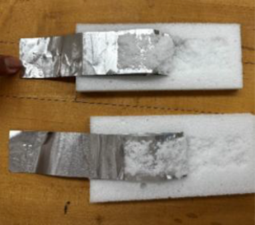
Clean peel occurs when the adhesive releases from the foam surface without significantly tearing or splitting the foam.
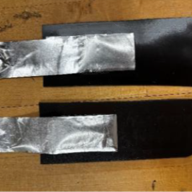
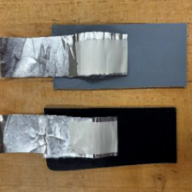
In a clean peel, the adhesive releases at the foam-to-adhesive interface with minimal damage to the foam.
This means the bonded interface, rather than the foam itself, limited the test result.
Engineers may need to review:
A clean peel does not automatically mean the bond is unacceptable. Foam split may be difficult or impossible to achieve with some foams because of their cohesive strength, making clean peel an acceptable result in many applications. The acceptable outcome depends on what the PSA must do in the final design, whether that is holding the gasket in place during assembly or withstanding vibration, repeated access, environmental exposure, or unsupported edges.
Cohesive failure occurs within one of the bonded materials rather than through a clean release at the foam-to-adhesive interface.
When the foam separates internally, leaving foam attached to both sides, it is called a foam split.
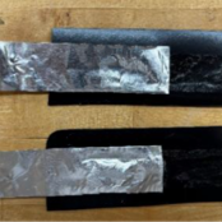
Cohesive failure (coh), PORON
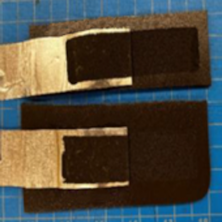
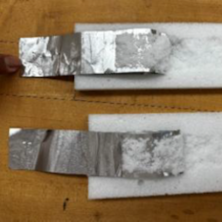
During foam split, the foam tears internally while the bond stays intact.
The measured peel force is then influenced by the foam’s own properties, not just the adhesive interface. This can make the force rise and fall during the test. A lower or more variable result does not necessarily mean poor adhesion because the foam may have failed first.
In this study, substrate failure occurred when the foam tore while the foam-to-adhesive interface remained intact.
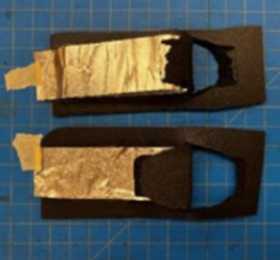
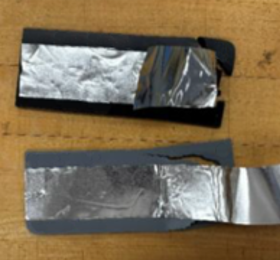
During substrate failure, the foam tears before the adhesive releases from the foam surface.
Under the test conditions, this indicates that the bond exceeded the foam’s internal strength.
Two adhesive constructions may both produce foam tear even if their measured peel values are different. Once the foam becomes the limiting factor, the failure mode alone may not clearly distinguish the strength of the foam-to-adhesive interfaces.
This result shows that the foam-to-adhesive interface did not release first. It does not validate the finished gasket or predict performance on the final enclosure surface. Substrate failure is one part of the bonding evaluation, not proof that the complete enclosure component is ready for use.
Softer foams may tear before the adhesive interface fully releases. When that happens, several adhesive constructions can produce similar failure modes because the foam, rather than the bond, limits the test.
Firmer foams may allow clearer differences to appear because they resist internal tearing longer. This does not mean firmer foam creates a stronger bond. It means foam properties influence what the peel test can reveal.
Failure mode provides useful context, but the finished gasket still requires application-specific validation.
That validation often requires coordination across the foam, adhesive, and converting process. As a Preferred Converter for both Rogers and 3M™, Marian helps bring those pieces together, with access to material options and technical support from both suppliers.
Sign up for the free Enclosure Institute™ foam bonding elective to:
Sealing challenges can make or break an enclosure’s performance. Whether you're designing for environmental protection, long-term reliability, or compliance with industry standards, selecting the right materials and understanding effective sealing strategies are critical. That’s why Marian Inc. and Rogers Corporation have partnered to bring you the Enclosure Institute—a free learning platform designed to help engineers navigate the complexities of enclosure sealing.
Gain exclusive access to:
The Enclosure Institute is designed for engineers at all levels, whether you're new to enclosure sealing or looking to refine your expertise.
Enroll today to take the next step in mastering enclosure design.
If you have a specific enclosure challenge and need expert guidance, Marian’s team is ready to help. Contact Marian directly for tailored recommendations and support.
Not ready to enroll yet? Explore more blogs on enclosure design best practices:
Whether you need expert guidance, high-quality materials, or precision-fabricated components, our partnership ensures your enclosures meet the highest industry standards while optimizing efficiency and cost-effectiveness.
If you have a specific enclosure challenge and need expert guidance, Marian’s team is ready to help. Contact Marian directly for tailored recommendations and support.
Published on Aug 10, 2026