Published
by Rogers Corporation
Elastomeric Material Solutions
Sustainability language is everywhere, but in high-performance materials, the word “sustainable” is not specific enough on its own.
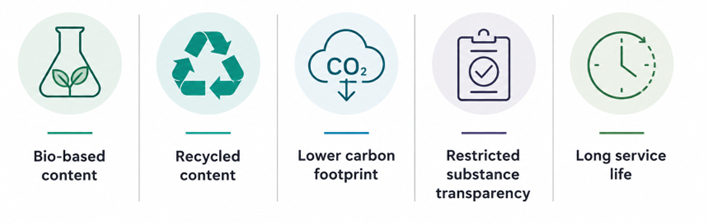
One material may include recycled content. Another may use bio-based content. Another may show a lower carbon footprint, avoid certain restricted substances, or simply last longer in the application.
Each of those things can matter, but they do not all mean the same thing. And for engineers, that distinction is important.
A sustainability claim needs to be evaluated the same way any material claim would be evaluated. What is being claimed? How was it measured? Is there documentation behind it? And does the material still meet the performance requirements of the application?
We spoke with Loni Decelles, Product Compliance Analyst at Rogers Corporation, about how sustainability conversations have evolved, what engineers should look for in material claims, and how PORON® ReSource30 polyurethane foam fits into that larger conversation.
Loni Decelles, Product Compliance Analyst at Rogers Corporation
Sustainability has been talked about for a long time, but the way customers define it has changed quite a bit.
Years ago, many requests were very specific and customer driven. One customer might ask for more bio-based content. Another might ask whether a material could be recyclable or compostable. Another might care most about carbon footprint.
Those are all very different requests, and they can lead development teams in very different directions.
What has changed is that sustainability is becoming less of a “nice-to-have” and more of a baseline expectation. Larger companies are working toward climate goals, supplier reporting requirements, and regulatory milestones, pushing sustainability earlier into material conversations.
The question is no longer about whether the material can perform. More often it’s, can this material perform and help support our sustainability goals?
Sustainability can mean several different things to different people.
A material with bio-based content does not automatically have the lowest carbon footprint. A product with recycled content still needs to be evaluated for performance, availability, processing, and total carbon impact. A material designed for long-term durability may help reduce replacement and waste, even if it is not recyclable or compostable.
As Loni says, “That is why the first step is understanding what the customer is trying to accomplish.
Is the customer trying to meet an internal carbon reduction target? Are they responding to an OEM requirement? Are they supporting a sustainability report? Or are they looking for restricted substance documentation?”
Once that is clear, the material discussion can get somewhere.
For engineers, the most important thing is specificity. Terms like “green,” “eco-friendly,” or “more sustainable” are not enough. A stronger claim should make clear what changed in the material, how the claim was measured, and whether there is documentation or third-party analysis behind it.
Just as important, the material has to meet the performance requirements of the application.
PORON ReSource30 foam is one example of making sustainability more measurable within an existing high-performance material platform.
The material incorporates 42% sustainable content by weight, including 27% bio-based content and 15% post-industrial recycled content. Based on third-party life cycle analysis, PORON(R) ReSource30 foam can deliver an approximately 30% lower carbon footprint compared to standard PORON 30-grade polyurethane foam when comparing equivalent grades at reduced densities.
Those are specific claims backed up by data, and that matters.
The other part of the story is performance. PORON ReSource30 foam was developed to maintain the long-term performance characteristics engineers expect from PORON 30-grade materials.
That is important because sustainability cannot be evaluated in a separate bucket. Engineers still need to understand compression behavior, stress relaxation, durability, sealing force, cushioning, and fit within the application.
The goal is not to ask teams to redesign around sustainability, rather it is to give them a more sustainable material option that can be evaluated through familiar technical criteria.
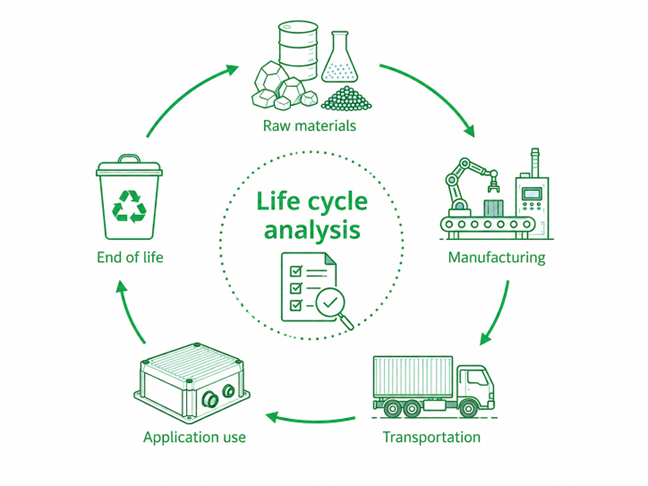
Life cycle analysis helps make the conversation more data driven.
When evaluating sustainability, it is not enough to look only at the material itself. There are impacts tied to raw materials, transportation, manufacturing, and other inputs. Sometimes a material change may appear more sustainable at first, but once the broader carbon footprint is evaluated, the answer may be more complicated.
That is why third-party analysis can be valuable. It helps quantify carbon impact and gives teams a stronger basis for the claims they make.
For PORON ReSource30 foam, third-party life cycle analysis supports the approximately 30% lower carbon footprint compared to standard PORON 30-grade polyurethane foam.
That kind of data helps keep the conversation objective. It gives engineering, procurement, and sustainability teams something more concrete to evaluate instead of relying on broad sustainability claims.
Engineers should start with the application.
As Loni says, “The material still needs to do its job. It still needs to meet compression, durability, environmental, fit, and performance requirements. Once that baseline is clear, then teams can look at the sustainability claim and ask whether it is specific, quantified, and supported.”
A few helpful questions include:
The best sustainability conversations are connected to the same design criteria engineers already use to make material decisions.
Sustainability in high-performance materials requires balancing chemistry, performance, supply chain realities, manufacturing, customer expectations, regulatory requirements, and credible data.
Due to these reasons engineers should be cautious with broad claims and look for materials that connect sustainability benefits to measurable attributes and proven performance.
PORON ReSource30 foam represents a practical step in that direction. It gives engineering teams a way to evaluate sustainable content and lower carbon impact within a familiar polyurethane foam platform, while keeping the focus on the performance requirements that still matter most.
PORON ReSource30 foam incorporates 42% sustainable content by weight, including 27% bio-based content and 15% post-industrial recycled content. It also delivers an approximately 30% lower carbon footprint compared to standard PORON 30-grade polyurethane foam, based on third-party life cycle analysis.
Connect with a Rogers Sales Engineer to learn whether PORON ReSource30 material may be a fit for your application.
Published on Jun 30, 2026