Published
by Rogers Corporation
Elastomeric Material Solutions
An engineer gets a material option across their desk with a lower carbon footprint claim.
At first, the number looks straightforward. Lower is better, right?
But then the questions start. What was included in the calculation? Was it based on the same material weight or the same finished part? Did the lower-carbon option still meet the same compression target? If the density changed, did the analysis account for using less material?
That is where a carbon footprint number becomes more than a number; it becomes a comparison that needs context.
Life cycle analysis, or LCA, helps provide that context. It gives engineering, procurement, and sustainability teams a structured way to understand what was counted, what was compared, and how the carbon reduction was calculated.
For PORON® ReSource30 polyurethane foam, LCA helps explain the carbon reduction in two ways: what changes in the material itself and what can change in the finished part when a reduced-density grade uses less material to meet the same performance target.
Life cycle analysis helps estimate where a material’s carbon impact comes from.
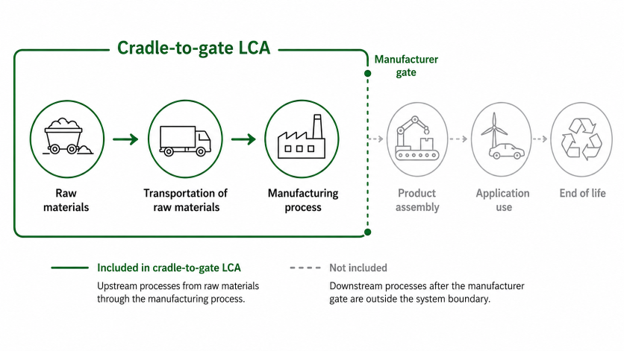
For PORON ReSource30 foam, the LCA looks at the product from raw materials through the point it leaves Rogers’ facility. This is commonly called a cradle-to-gate analysis.
In this case, the cradle-to-gate view includes raw materials, transportation of those raw materials, and the manufacturing process. It stops at the Rogers “gate,” before downstream steps such as product assembly, application use, and end of life.
That boundary matters because a carbon reduction claim only makes sense if you know what was counted.
Engineers are increasingly being asked to consider sustainability alongside performance, but carbon footprint claims are not always measured the same way.
LCA helps clarify what was counted, what assumptions were used, and whether the claim is based on material-level or finished-part carbon impact.
That context matters because a lower-carbon foam still must work in the design. It still needs to meet compression targets, sealing requirements, cushioning needs, durability expectations, and fit within the application.
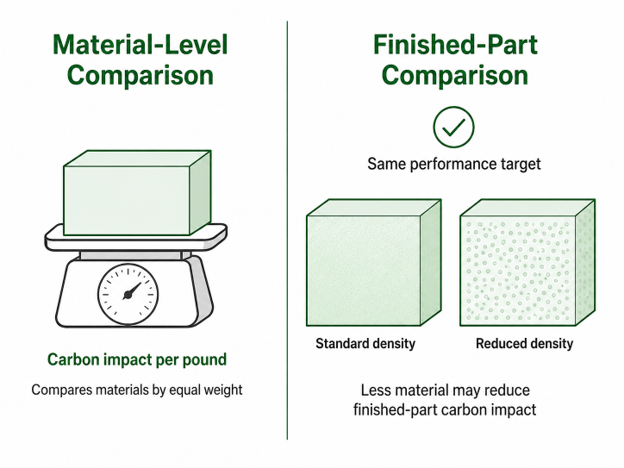
Carbon footprint is often measured by weight, such as carbon impact per pound or kilogram of material. That is useful, but it may not tell the full story for a finished part.
For foam, density can change the comparison. If a lower-density foam meets the same compression force deflection targets or application requirements, the finished part may use less material overall.
Think of it like packaging: if two materials protect the same product, but one does it with less material, the finished package may have a lower overall impact.
Foam can work the same way. When a reduced-density grade meets the same performance target, the carbon impact may improve because less material is needed to do the same job.
That is why material-level carbon reduction,and finished-part carbon reduction can both be useful, but they answer different questions.
PORON ReSource30 foam was developed as a lower-carbon option within a familiar PORON 30-grade material performance range.
The material incorporates approximately 42% sustainable content by weight, including 27% bio-based content and 15% post-industrial recycled content.
Based on ISO-aligned life cycle analysis, PORON ReSource30 foam delivers an approximately 11% lower carbon footprint per pound compared to standard PORON 30-grade polyurethane foam.
The finished-part impact can be even stronger when a reduced-density PORON ReSource30 foam meets the same application requirements. Because the material can run at approximately 20–25% lower density while maintaining compressive performance, the finished part may use less foam overall.
In those cases, PORON ReSource30 foam can support approximately 30–35% lower carbon impact for finished parts compared to equivalent standard PORON 30-grade polyurethane foam.
The difference comes down to the comparison. The 11% reduction looks at carbon impact by material weight. The 30–35% reduction looks at the finished part, where reduced density can mean less material is needed to meet the same performance target.
LCA helps explain carbon impact, but it does not replace application validation. A lower-carbon foam still needs to meet the same performance requirements, including compression behavior, durability, sealing force, cushioning performance, and fit.
When reviewing a lower-carbon material claim, engineers should ask:
These questions help keep sustainability claims connected to real material decisions, not just a headline number.
For PORON ReSource30 foam, that is the value of LCA. It helps show how sustainable inputs, reduced density, material usage, and performance requirements work together in the finished part.
When comparing lower-carbon materials, look beyond the headline percentage. Ask what was counted, what was compared, and whether the material can meet the same performance target in the finished part.
For PORON ReSource30 foam, LCA helps explain how carbon impact can change at both the material level and the finished-part level when reduced-density grades are used in the right application.
Connect with a Rogers Sales Engineer to discuss whether PORON ReSource30 material may be a fit for your design requirements.
Published on Aug 10, 2026