Published
by Rogers Corporation
Elastomeric Material Solutions
What do fossils and bio-based materials have in common?
They both carry clues in their carbon.
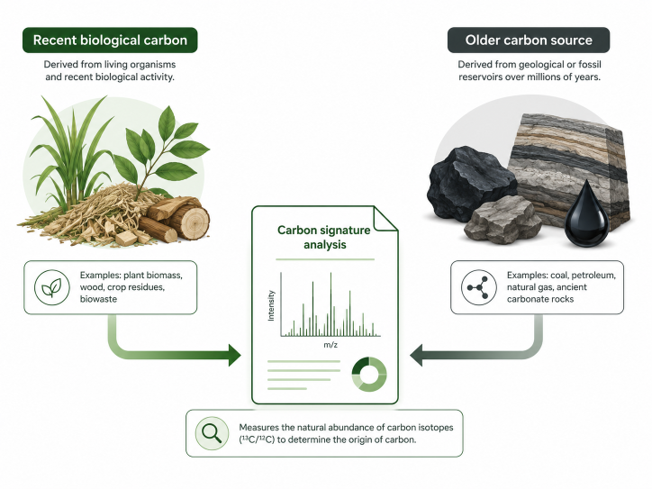
Carbon dating is often associated with fossils, archaeology, and ancient artifacts. Scientists use carbon signatures to understand whether something came from the recent living world or from a much older carbon source.
Biogenic carbon testing applies a similar idea to modern materials.
For engineers, that matters because a bio-based claim should not rely on trust alone. The question is not whether a supplier says a material includes bio-based content, but rather how that claim is supported.
Biogenic carbon testing helps answer the question by looking for the carbon signature of recent biological sources, such as plant-derived inputs.
For PORON® ReSource30 polyurethane foam, this type of third-party testing helps support the bio-based portion of the material’s sustainability story.
Biogenic carbon testing helps determines how much of a material’s carbon came from recent biological sources, such as plants.
It works a bit like carbon dating. Living things carry a modern carbon signature because they absorb carbon from the atmosphere as they grow. Older carbon sources have a different signature. Testing can use that difference to help identify plant-derived carbon in a material.
For PORON ReSource30 foam, this testing was performed using ASTM D6866-24 Method B, a standard radiocarbon-based method used to help determine biogenic carbon content.
Instead of asking, “How old is this material?” biogenic carbon testing helps answer a different question:
How much of this material’s carbon came from recent biological sources?
That makes it a useful tool for supporting bio-based material claims.
Bio-based claims are becoming more common, but engineers need more than broad sustainability language.
They need to know what changed, how it was measured, and whether the material still performs in the application.
Biogenic carbon testing helps make the bio-based portion of a claim more defensible by adding third-party data. That is especially useful when engineering, procurement, and sustainability teams are all involved in the decision. Each group may care about the claim for a different reason, but all of them need clear information they can evaluate.
Biogenic carbon testing supports one specific part of the sustainability story: how much of the carbon in a material comes from recent biological sources, such as plant-derived inputs.
It does not answer every sustainability question.
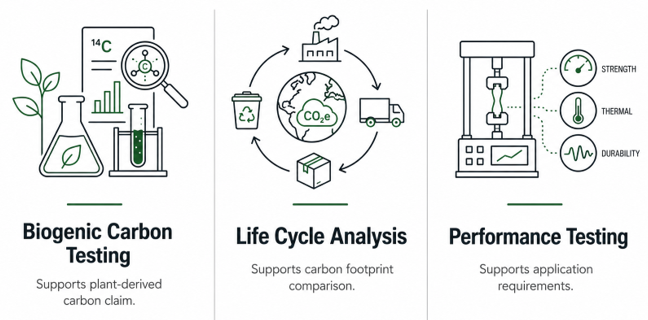
Here is a simple way to think about it:
For engineers, that distinction matters. A bio-based claim can support a sustainability goal, but it does not replace the need to evaluate compression behavior, durability, stress relaxation, sealing force, cushioning performance, or fit within the application.
PORON ReSource30 foam incorporates approximately 42% sustainable content by weight, including 27% bio-based content and 15% post-industrial recycled content.
Those numbers are important, but the supporting data behind them is what makes the claim useful.
As part of the validation process, third-party biogenic carbon testing using ASTM D6866-24 Method B was used to confirm the fraction of plant-derived carbon in the formulation. This helps support the bio-based portion of the material’s sustainability claim.
For engineers, that matters because numbers need context and substantiation. Biogenic carbon testing helps support the source from which the carbon came. Life cycle analysis helps evaluate carbon impact. Performance testing helps confirm the material can still meet familiar PORON 30-grade material expectations.
Together, those supporting data points make the sustainability story more practical. They connect the claim back to the same kind of technical evidence engineers already use when specifying polyurethane foam materials.
When evaluating bio-based materials, engineers should ask three practical questions:
Biogenic carbon testing helps answer the second question by supporting plant-derived carbon claims with third-party data.
But the other questions still matter. The claim needs to be clearly defined, and the material still needs to perform.
That is the practical value of PORON ReSource30 foam. Its bio-based content is supported by testing, its carbon reduction story is supported by life cycle analysis, and its performance is designed to align with the expectations engineers already have for PORON polyurethane foam.
Bio-based material claims are most useful when they are supported by clear data and tied back to real performance requirements.
Connect with a Rogers Sales Engineer to learn whether PORON ReSource30 material may be a fit for your application.
Published on Aug 10, 2026